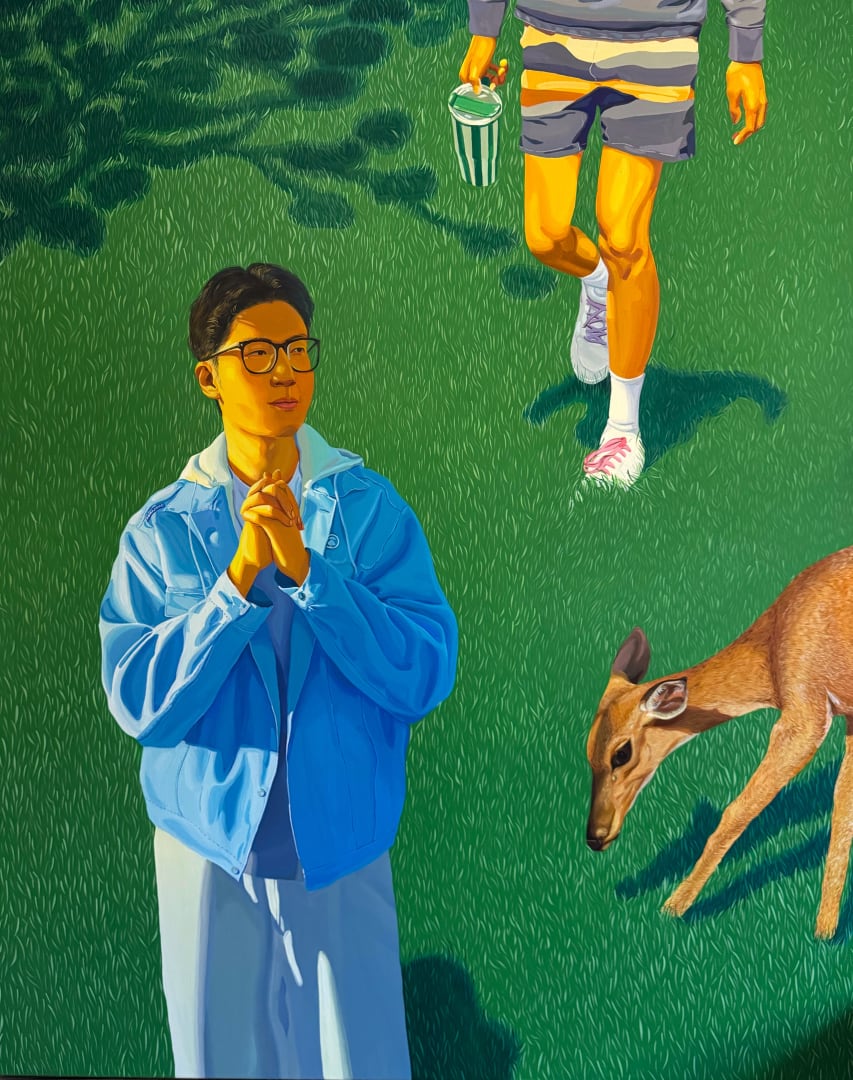
Fragment is delighted to present Li Wang’s second solo show in New York. This body of work spans the last three years following his MFA at Columbia University, during a formative period spent between the Monira Foundation Residency and his life in Harrison, Jersey City. Together, these paintings reflect on the experiences, desires, and emotional atmospheres that shaped his time in the United States.
Opening: January 7, 6–8 pm.
Throughout these works, light serves as the central entry point into emotion. Wang understands illumination not only as the brilliance of a summer afternoon but also as the crisp clarity of winter sunlight and the warm glow of interior lamps. Whether a dim bedroom light, the sharp reflection of a bathroom fixture, or an ambiguous beam slipping through a window, each variation of light opens onto moments shaped by desire, hesitation, and memory. As illumination shifts, the paintings move between softness and clarity, disclosure and ambiguity.
In his early period, Wang briefly drew on modernist precedents — most notably Bonnard, from whom he took the play with color and a pointillist manner, both of which he later moved away from. In this newer body of work, the surfaces flatten, the palette tightens, and the compositions move toward the emotional clarity found in certain strands of queer figurative painting. His bright, distilled chromatic fields resonate with the psychological temperature of David Hockney’s works from the 1970s and ’80s, where color becomes a register of longing and interior emotion.
The figures inhabiting Wang’s paintings often appear watching, pausing, or lost in thought — observing a cowboy striptease, absorbing fragments of queer internet culture, or sitting quietly in private corners. They are not typically portraits of specific individuals but composites of memory, cultural experience, and the small, ambiguous moments of the artist’s own formation. Their atmosphere subtly recalls the coded desire of Paul Cadmus, the observational tension of Patrick Angus, and the tender introspection of Hugh Steers, while also resonating with the highly stylized, emotionally charged sensibility of Kyle Dunn, whose work similarly blends theatrical lighting, queer desire, and sculptural figuration.
Objects surrounding the figures — white socks, toys, pieces of clothing — remain ordinary yet emotionally charged. Light moves across bodies and things, giving these objects a subtle, intimate vibration and allowing desire to surface indirectly and quietly. Through saturated colors, tender contours, and symbolic fragments of everyday life, Wang lets his figures drift between intimacy, shyness, longing, and self-reflection.
As Wang paints the relationship between light and the body, he also looks back at himself: at the moments that shaped his personality, his desires, and his understanding of identity; at the ways sunlight and interior light have influenced how he perceives the world; and at a self still taking form, still searching for its own language. These paintings form both a closing chapter and an opening, marking Wang’s return to Beijing and the continued unfolding of his artistic and personal evolution.
